How does Germany compare internationally on digitalising its public administration?
Estonia, the Netherlands, Austria, the USA and the United Arab Emirates show how digital citizen service can work. A look across the borders — and at a German flagship example.
Many citizens in Germany would like to handle their dealings with public authorities digitally. In practice they still have to turn up at the office — and more often than in other countries.
When I look at Estonia, for instance, I do get a little envious. Since December 2024 every administrative service in the 1.3-million-inhabitant country can be completed entirely digitally – even divorces. Citizens automatically receive a digital identity at birth, with which they conveniently handle all their official business online, such as registering a change of address. Founding and running a company from abroad is likewise digital in Estonia, via the e-Residency ID.
The Netherlands combine digital processes with on-site service
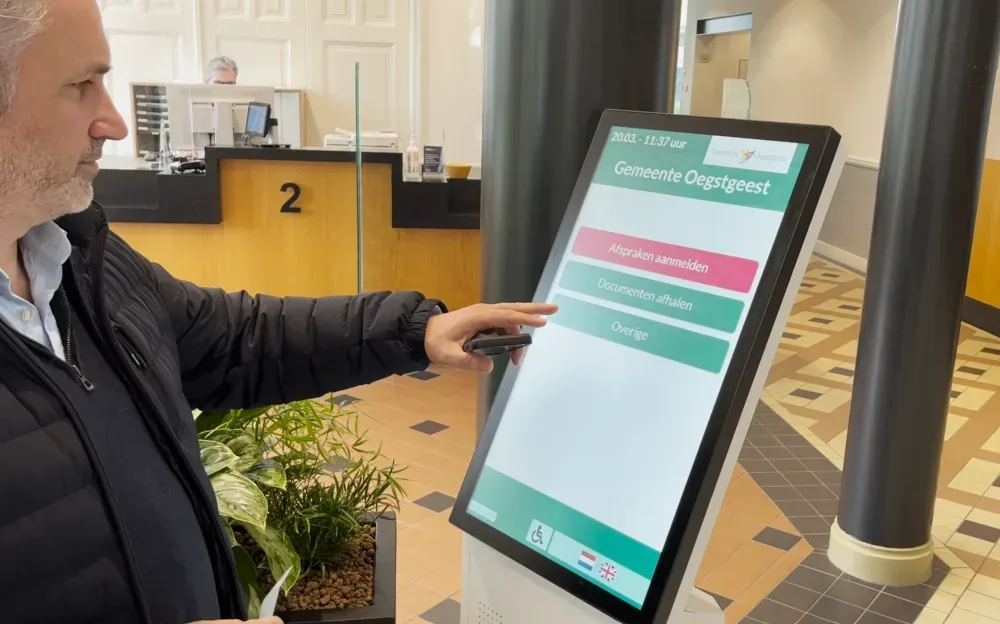
The Netherlands, too, rely on a digital identity that lets citizens authenticate themselves online. Classic administrative processes — child benefit claims, tax returns, change-of-address registrations, applying for a parking permit — are therefore largely possible digitally. At the same time, the Dutch still want to be advised in person when they need to be. The municipality of Oegstgeest in the western Netherlands, for example, implements this with our digital visitor management solution. Citizens can conveniently book an appointment through the municipal website and state their concern at the same time. Staff can prepare for those appointments and support citizens quickly and unbureaucratically when they visit the town hall.
Austria opts for uniform solutions
Austria, by contrast, aims to roll out locally implemented solutions nationwide. One example is the public employment service (AMS), a major service provider comparable to the Federal Employment Agency in Germany. The "U25 Wiener Jugendunterstützung" service centre of the AMS in the federal capital faced considerable challenges because of its complex structure. To coordinate services between the various departments more efficiently and route customers with their different concerns straight to the responsible desks, the AMS first implemented our visitor guidance and queue management solution in its Vienna "U25". After the successful rollout it is to be used in 70 further branches across Austria — something we are very much looking forward to.
Efficiency has gained importance in the USA
Public administrations in the USA are at very different stages of digitalisation. At federal level, initiatives such as the U.S. Digital Service have modernised legacy IT systems and made services more citizen-friendly. Some states and large cities now offer their services largely digitally too. Smaller municipalities, on the other hand, are often still far from a fully digitalised administration, so citizens cannot avoid the trip to the office. To make that trip as convenient and quick as possible, the Wilmington License Plate Agency vehicle registration office, for instance, introduced our queue management solution. Arriving citizens now select the service they want at a terminal and are informed of the expected waiting time. At the same time our system gives those in charge an overview of daily visitor volumes, so they can plan staffing deliberately and even out peaks in demand.
Administration as a service experience in the UAE
In the United Arab Emirates the federal government places great value on impeccable service in public administration. There is a reason the citizen offices there are called "Customer Happiness Centers", where artificial intelligence steers waiting times efficiently. Whenever I visit our branch in Dubai, I am struck again by how quickly and smoothly my visa application is processed.
The state capital Hannover is stepping up digitalisation in public-facing services
In Germany, too, towns and municipalities are becoming more digital and therefore more efficient, and are improving their citizen service. Our flagship example is the state capital Hannover, whose citizens can submit applications digitally through a service portal. The offering is growing in popularity and has already recorded 2.2 million website visits. Citizens can also use the portal to book an appointment online at the citizen office or the responsible department with our solution. This lets the city of Hannover match staffing more precisely to expected demand, while employees use the solution to steer waiting times efficiently in each area. Hannover is also the first municipality in Germany to combine online appointment booking with the digital building guidance system from Catchup Applications, which reliably navigates users to their assigned waiting zone.
My personal conclusion
In the recently published Bitkom DESI index, Germany ranks only 21st out of 27 EU states on "digitalisation of public administration". So there is plenty of room for improvement. The examples from Estonia, the Netherlands, Austria, the USA and the United Arab Emirates show us very vividly how committed initiatives and innovative solutions can drive digitalisation forward. But in Germany as well, more and more towns and municipalities are implementing the digital transformation and making their service more citizen-friendly — while relieving their staff through automated processes in customer management.
 Matching success story Intelligentes Customer Journey Management im Praxiseinsatz beim AMS in Österreich. Arbeitsmarktservice (AMS) Österreich — Read the full reference
 As CEO of Smart CJM, Stefan Dylka is responsible for the strategic direction of the company and follows digitalisation across all sectors worldwide.
Get in touch