
Solutions · healthcare
Optimise patient flows. With Smart NexCX.
Smart NexCX steers the patient journey in hospitals, medical centres, health insurance branches and large group practices: online booking around the clock, check-in on arrival, contactless call-up in the waiting area and analysis of utilisation. Reception, outpatient departments and administration all work on the same data.
Where things stand
How does a hospital reduce waiting times in outpatient care?
Waiting time rarely arises during treatment — it arises on arrival: patients turn up unmanaged, reception answers calls at the same time, and cancelled appointments stay unfilled. Running arrival, order of service and the appointment stock in one system flattens the peaks — without extra posts at reception.
Full waiting areas, unclear call-ups
Anyone who does not know when they will be called stays seated and asks. That ties up staff at reception and makes an orderly sequence look invisible.
The phone as the bottleneck
Booking, rescheduling and information all run over the same line at the same time. Calls during consultation hours arrive exactly when nobody at reception is free.
No-shows and gaps in the schedule
A missed appointment costs treatment capacity that does not come back that day — unless the freed slot is immediately available for booking again.
The platform
What does Smart NexCX do along the patient journey?
Smart NexCX covers the complete course of a visit in one platform: booking before the visit, check-in on arrival, waiting and call-up inside the building, and the analysis afterwards. Every standard function of the appointment and call-up system is part of the platform and can be switched on at any time; individual modules need no extra licence.
Before the visit
The appointment is made at home
Patients choose the department and their concern, see the free slots and book bindingly.
- Online booking around the clock
- Booking in the chat, in natural language
- AI phone assistant for booking and rescheduling
- A reminder before the visit
Arrival
Check-in without a queue
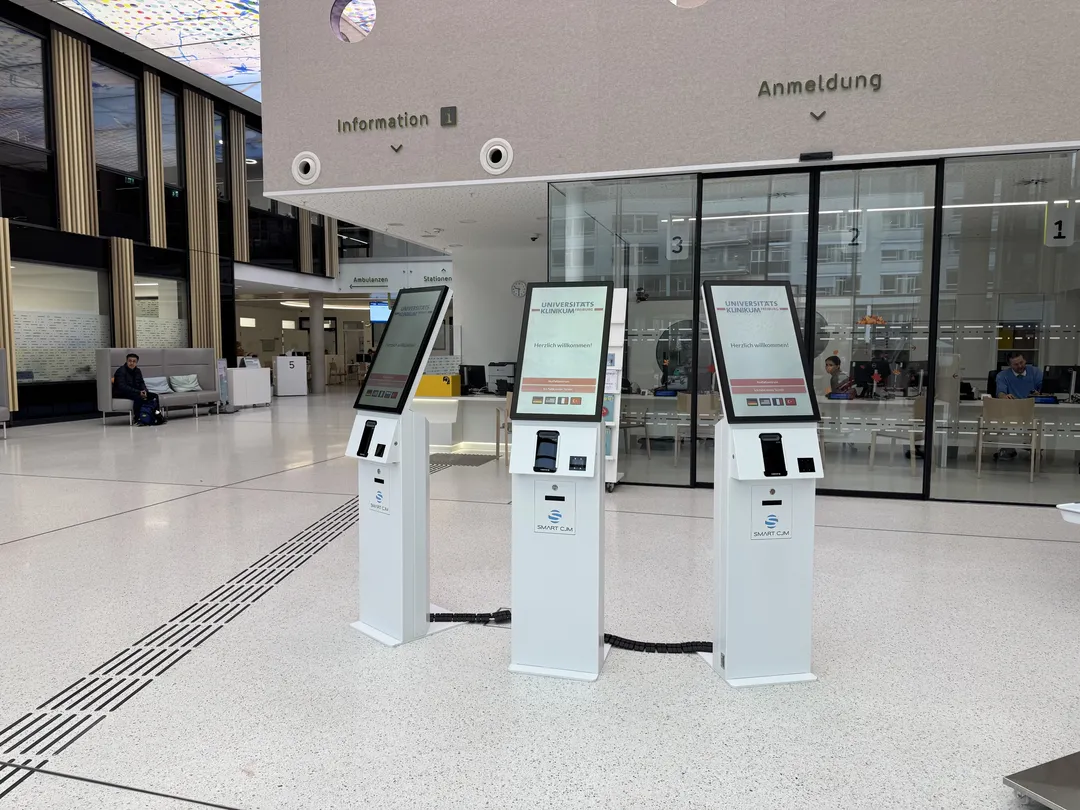
Patients check in themselves at the terminal — with an appointment by QR code or date of birth, without one by choosing their concern.
- Self-service terminal for check-in
- Routing to the right consultation
- Electronic ticket on the smartphone
Waiting and call-up
Called forward, contact-free
The live ticket shows waiting time and position; the call-up names the treatment room and the way there — on the screen or on the patient’s own device.
- Live ticket with waiting time and position
- Contactless call-up and forwarding
- Prioritised call-up by the rules of the house
Afterwards
The day becomes figures
Every process is documented. That is the basis for the duty roster and for managing capacity.
- Dashboard with patient flows in real time
- Reporting per consultation and site
- Automated reports with a recommended action
Functions
Which functions does Smart NexCX offer healthcare institutions?
The functions of Smart NexCX are grouped by the three roles that meet in a healthcare institution: patients, staff at reception and in outpatient care, and management. An appointment booked online is the same process at the check-in terminal, in the call-up and in the reporting.
For patients
The channels a visit begins and runs through.
- Online booking — bookable around the clock, without a call and without opening hours
- Check-in at the terminal — registration by QR code, date of birth or choice of concern
- Live ticket — joining the queue by phone, with waiting time and position
- Mobile info — electronic ticket, status and call-up on the patient’s own device
- Contactless call-up — called forward and directed on, with no name spoken in the waiting area
For staff
The workplaces at reception and in outpatient care.
- Reception — registration, assignment and information at one desk
- Call centre — booking by phone, on the same data
- Call-up desk — calling forward, handling and documenting at the treatment station
- Prioritised call-up — rules for emergencies, pregnant patients and people with reduced mobility
For management
The view of utilisation and results.
- Dashboard and operations — patient flows, waiting time and utilisation in real time
- Reporting — figures on throughput time, no-shows and capacity
- Business intelligence — utilisation per consultation, department and site
- Administration — consultation hours, appointment types and rights maintained centrally
Integration and compliance
How does Smart NexCX fit into an existing IT landscape?
Smart NexCX is built API-first and exchanges data with the institution’s systems over open interfaces. It runs in the cloud with hosting in Germany or on-premises in your own data centre — data sovereignty stays with the institution. Multi-tenancy, multilingualism and accessibility to BITV 2.0 and WCAG 2.1 AA are part of the platform.
Interfaces
API-first: REST · GraphQL
Calendar synchronisation with Microsoft 365 and Google, webhook routing for events.
Data protection
GDPR · ISO 27001
Certified processes, documented processing, delivery over a CDN.
Operation
On-premises or cloud
Hosting in Germany or in your own data centre. Data sovereignty stays in the house.
Organisation
Multi-tenant
Houses, outpatient departments and specialities managed separately, analysed together.
Languages
Multilingual
Patient interfaces and AI dialogue in several languages, depending on the package.
Accessibility
BITV 2.0 · WCAG 2.1 AA
Contrast, keyboard operation, focus states and text alternatives throughout.
Call-up
Contactless if you want
Joining the queue and being called forward on the patient’s own phone, with no paper ticket.
Technical detail on operation and security is on the Smart NexCX product page.
Who it is for
Which healthcare institutions is Smart NexCX suited to?
Smart NexCX is the platform for patient journey management in hospitals and clinics, medical centres, health insurance branches, specialist centres and large practices, as well as in public health offices, vaccination and testing centres. It steers booking, patient flows and communication wherever heavy public traffic meets limited treatment capacity.
Hospitals and clinics
Central admissions, outpatient departments and the emergency department run in parallel; groups steer several houses with different levels of utilisation.
Smart NexCX spreads out arrivals through check-in and the live ticket, prioritises the call-up by the rules of the house and runs the sites of a group multi-tenant from one platform.
Medical centres
Many specialities sit under one roof and share a reception — with different appointment lengths and preparations.
Appointment types per department, separate queues and a shared check-in guide patients to the right consultation without loading reception.
Health insurance branches
Advisory conversations require confidentiality and prepared case handling; a branch network requires management across sites.
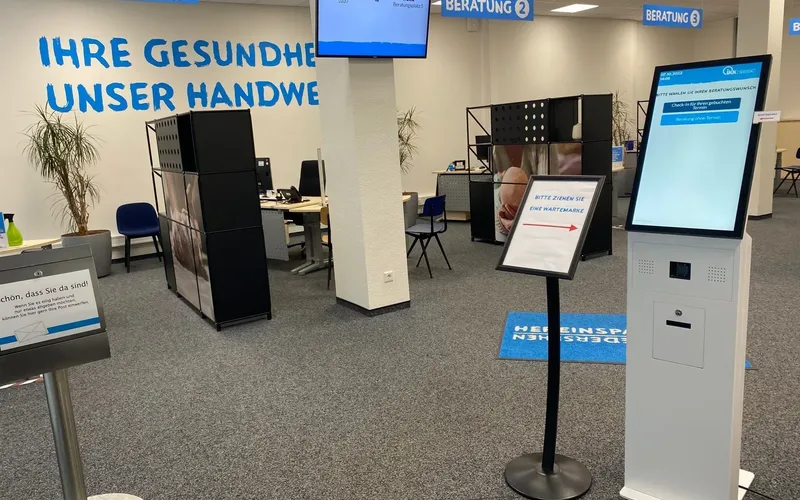
Online booking with a choice of concern routes to the right advisory desk, and the call-up names no names. Reference: IKK classic with around 160 service centres.
Specialist centres and large practices
Being reachable by phone is the bottleneck: calls arrive right in the middle of consultation hours, and no-shows go unnoticed until the appointment.
Smart Connect AI Voice answers calls around the clock and books on its own; automated reminders and easy rescheduling reduce the no-show rate.
Public health offices, vaccination and testing centres
Peaks appear at short notice, and walk-ins meet booked appointments in the same waiting area.
Queue management scales with the rush and separates booked visits from walk-ins. Further administrative use cases are on the public administration page.
Rehabilitation centres, laboratories and blood donation services steer their visitor flows with Smart NexCX too.
Request a demo for your institutionReference
Which healthcare institutions work with Smart CJM?
IKK classic deployed Smart CJM in around 160 service centres and connected online booking with prepared advice on site. Results from more than 200 sites are available in total.
Frequently asked
Questions from hospitals, medical centres and practices
Which interfaces can Smart NexCX be connected through?
Smart NexCX is built API-first: a REST and GraphQL API, calendar synchronisation with Microsoft 365 and Google Workspace and webhook routing for events are all available. Your own AI assistants can be connected through the open MCP standard.
Is the software GDPR-compliant, and can it run on-premises?
Yes. Smart CJM is ISO 27001 certified and processes personal data under the GDPR. It runs in the cloud with hosting in Germany or on-premises in the institution’s data centre. You connect the AI model yourself through an OpenAI-compatible interface — European-hosted services or a model of your own are possible too.
Can patients book appointments through the phone AI?
Yes. Smart Connect AI Voice answers calls around the clock, holds the conversation in several languages and books, reschedules or cancels appointments directly in the system. That takes load off the hospital and practice hotline at the times of heaviest call load.
Does calling patients forward work without contact?
Yes. Patients join the queue through the live ticket on their own phone, see the waiting time and their position and receive the call-up with directions on the device. Calling forward on screens in the waiting area works alongside it; a paper ticket is not required.
Is Smart NexCX suitable for hospital groups with several sites?
Yes. Smart NexCX is multi-tenant: houses, outpatient departments and specialities are managed separately and analysed together. Business intelligence shows utilisation per consultation, department and site.
How does Smart NexCX reduce the number of no-shows?
Through automated reminders and a low barrier to rescheduling: patients change their appointment themselves in the portal, in the chat or by phone through the AI voice assistant. Slots that free up are immediately available for booking again.
Can the call-up be prioritised?
Yes. Smart NexCX steers the order by rules the institution sets — for emergencies, pregnant patients or people with reduced mobility, for instance. The prioritisation applies to the call-up at the desk and to the display in the waiting area.
Details of the solution — as of August 2026